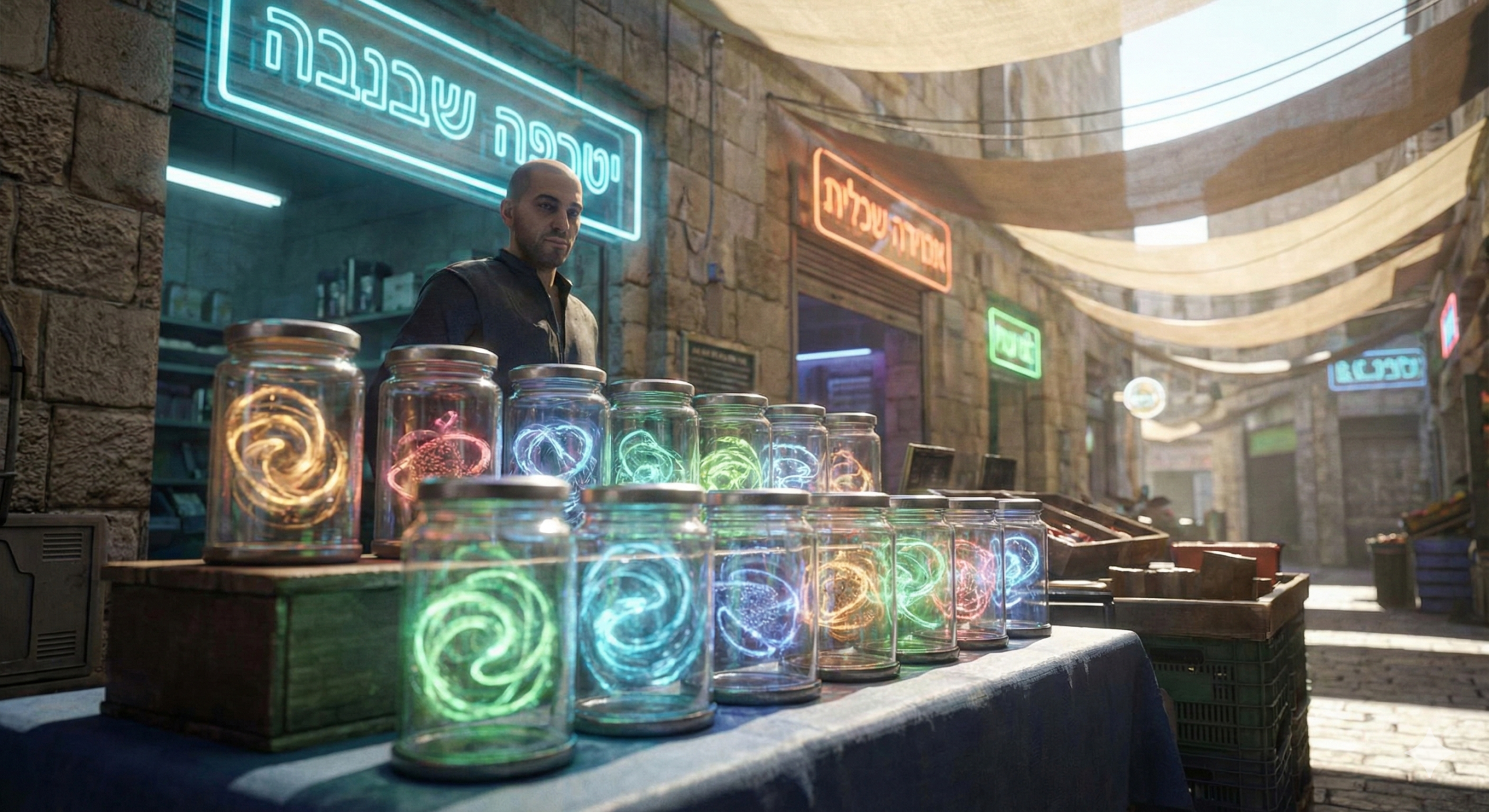
The year is 2025. Our digital lives are defined by “Walled Gardens.” If you want to edit a photo, you enter Adobe’s house. If you want to manage sales, you live inside Salesforce’s dashboard. We are tenants renting logic and storage from centralized landlords, accessing powerful clouds through relatively “thin” clients like laptops and phones.
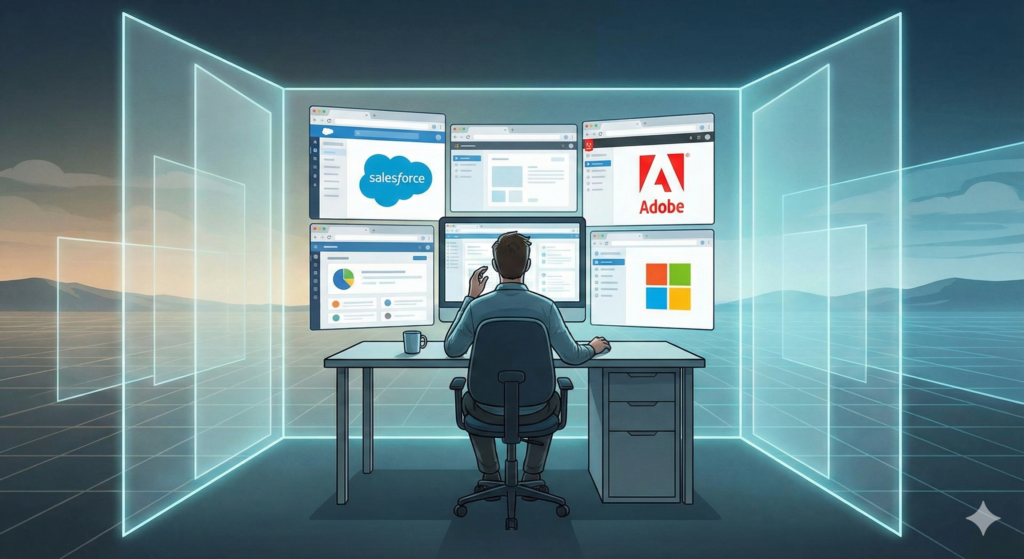
But what happens when the balance of power shifts?
Over the past few weeks, I’ve been exploring a provocative hypothesis about the next 25–50 years of computing. It began with a simple idea: What if personal compute becomes so cheap, powerful, and ubiquitous that the current model of centralized SaaS (Software as a Service) collapses?
Through rigorous debate, that idea has evolved. SaaS won’t die, but it will become absolutely unrecognizable. We are heading toward a future where you don’t rent “Apps”; you own the interface, and you command a global army of headless utilities.
Here is a glimpse into the “Sovereign Compute” era of the 2050s.
The Environment: The Rise of “Grist”
The foundation of this future is hardware. Forget Moore’s Law; imagine a trajectory where compute density explodes over the next three decades.
By 2050, you carry a device—let’s borrow* the term “Grist” from science fiction—that possesses the computational power of a modern-day data center, running on hyper-efficient power sources.
This shifts “Data Gravity.” Today, we send our data to the Cloud because that’s where the processing power is. In 2050, the processing power is on your hip. Your life’s history, medical data, and creative work reside locally in massive, secure vector databases.
The Cloud doesn’t disappear, but it is demoted. It becomes a public utility grid for raw storage and “burst compute” for massive physics simulations, much like you pull electricity from the grid today. But the “brain” of your operation has moved back home.

The New Interface: AI as the Ultimate Orchestrator
If you have supercomputer power and all your data locally, why do you need a SaaS website to manage your life? You don’t.
In this future, “The App” dies.
Instead, you have a highly personalized AI Agent. This Agent isn’t necessarily writing complex software from scratch every time you need something. Instead, it acts as the ultimate Orchestrator and Interface Layer.
It follows a scaled-up version of the Unix philosophy: lots of small, specialized tools that do one thing well, stitched together by a smart shell.
A Day in the Life without Apps
Imagine you want to edit a batch of photos to look like 1980s film stock.
- Today: You open an app like Lightroom, import photos, and use their specific sliders in their specific UI.
- 2050: You just look at your photos in your own self-generated interface and say, “Make these look like 80s film.”
Your AI Agent does the rest invisibly:
- It analyzes the request.
- It scans a global registry of available utilities.
- It instantly pipes your photos into a specialized “Film Grain Utility” (perhaps an open-source module running locally).
- It pipes that output into a “Color Grading Node” (perhaps a paid utility from a specialist vendor).
- It presents the finished result in your personal gallery.
You never saw a vendor’s logo, you never logged into a website, and you never installed an “app.” You had an intent, and your AI assembled a disposable workflow to achieve it.
The Fate of SaaS: Unrecognizable Utilities
If there are no apps to log into, how do software companies survive?
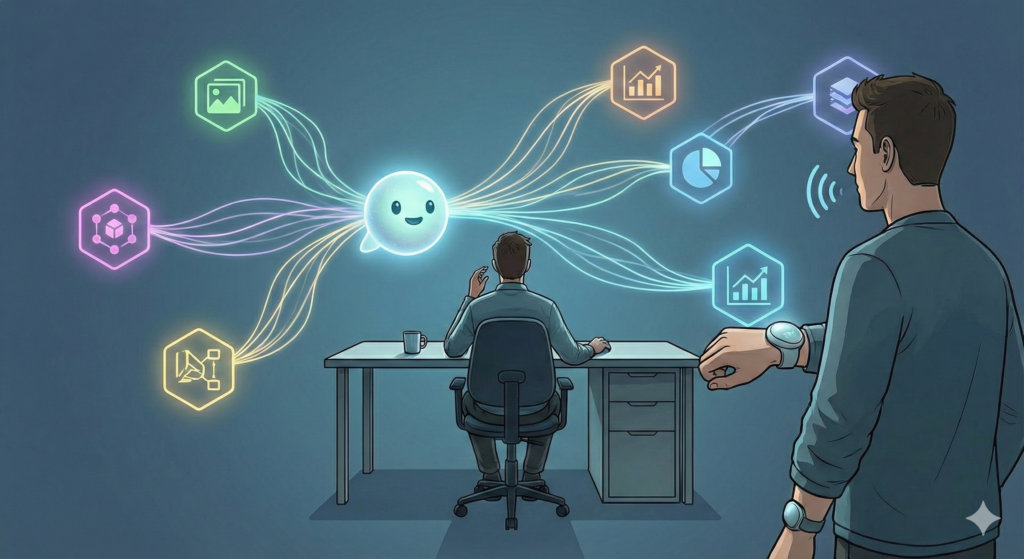
They stop building “Walled Gardens” and start building “Headless Utilities.” They strip away the expensive UIs, user management systems, and dashboards, and simply expose their core capability as a highly optimized API.
But how do they make money if they are invisible? This is where the model gets interesting. The new economy is built on Licensing and Compliance.
Your AI Agent isn’t just a router; it’s a real-time compliance officer managing a balance sheet of cost, attention, and branding.
The New Business Models:
- The Watermark License (Branding): A vendor like Adobe might offer a powerful image processing utility for free, but the license requires a holographic “Powered by Adobe” badge to appear in your vision while it runs. Your AI ensures this compliance to keep the utility working.
- Proof of Attention (Ad-Funded Compute): You want to run an expensive 3D render on the public grid but don’t want to pay credits? Your AI can negotiate a deal: watch a 15-second immersive ad, and your Grist uses eye-tracking to generate a cryptographic “Proof of Attention” token, which unlocks the compute resources.
- The Specialist Gig (Premium): For high-stakes tasks—like medical diagnosis or legal auditing—you won’t trust a generic utility. You will pay a one-time fee to rent a “Certified Specialist Agent” (e.g., from Mayo Clinic or Deloitte) that runs securely in an encrypted enclave on your hardware, performs the expert task, and then self-destructs.
Constraints and Friction: The “Dark Forest”
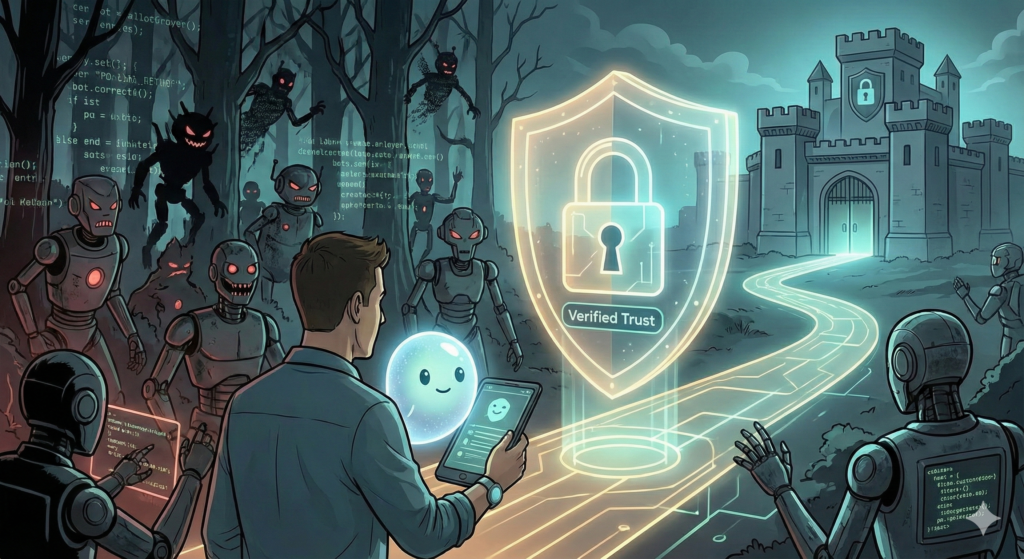
This decentralized future isn’t a utopia. A public grid where billions of autonomous agents are constantly negotiating is a noisy, dangerous place—a digital “Dark Forest.”
If you connect your Grist to the open grid, you will be bombarded by spam-bots, phishing agents, and malicious code trying to siphon off your compute credits.
The Solution: Reputation as a Service
Security doesn’t come from firewalls, but from Trust Brokers. A new class of centralized companies will emerge—the descendants of Visa or Verisign—whose only job is to maintain global reputation ledgers.
Before your AI accepts a packet or hires a utility from the grid, it queries these brokers: “Is this utility ID verified? Does it have a history of malware?”
You pay a micro-fee for this verification. In the end, you own the compute, you own the interface, but you still rent Trust.
The Great Decoupling
The future of computing is a shift in leverage. Today, vendors use their monopoly on compute and complex code to hold your user experience hostage.
In the 2050 vision, the user regains sovereignty. We decouple the Interface (which becomes personal) from the Logic (which becomes a utility). It is a chaotic, hyper-efficient, agent-driven world where the biggest software companies on earth might be ones you never actually see.
Join the Discussion
This scenario is a projection based on current trends in hardware scaling and AI agent protocols. It’s a hypothesis, not a destiny.
- Do you believe hardware will scale fast enough to make local compute dominant over the cloud?
- Can an AI orchestrator really replace the cohesive experience of a carefully designed app, or will fragmentation drive us back to centralized bundles?
- How would privacy laws evolve in a world where everyone runs their own personal data center?
Share your thoughts, critiques, and alternative visions in the comments below. Let’s debate the future of our digital infrastructure.
* Grist was taken from the book Metaplanetary by Toni Daniel